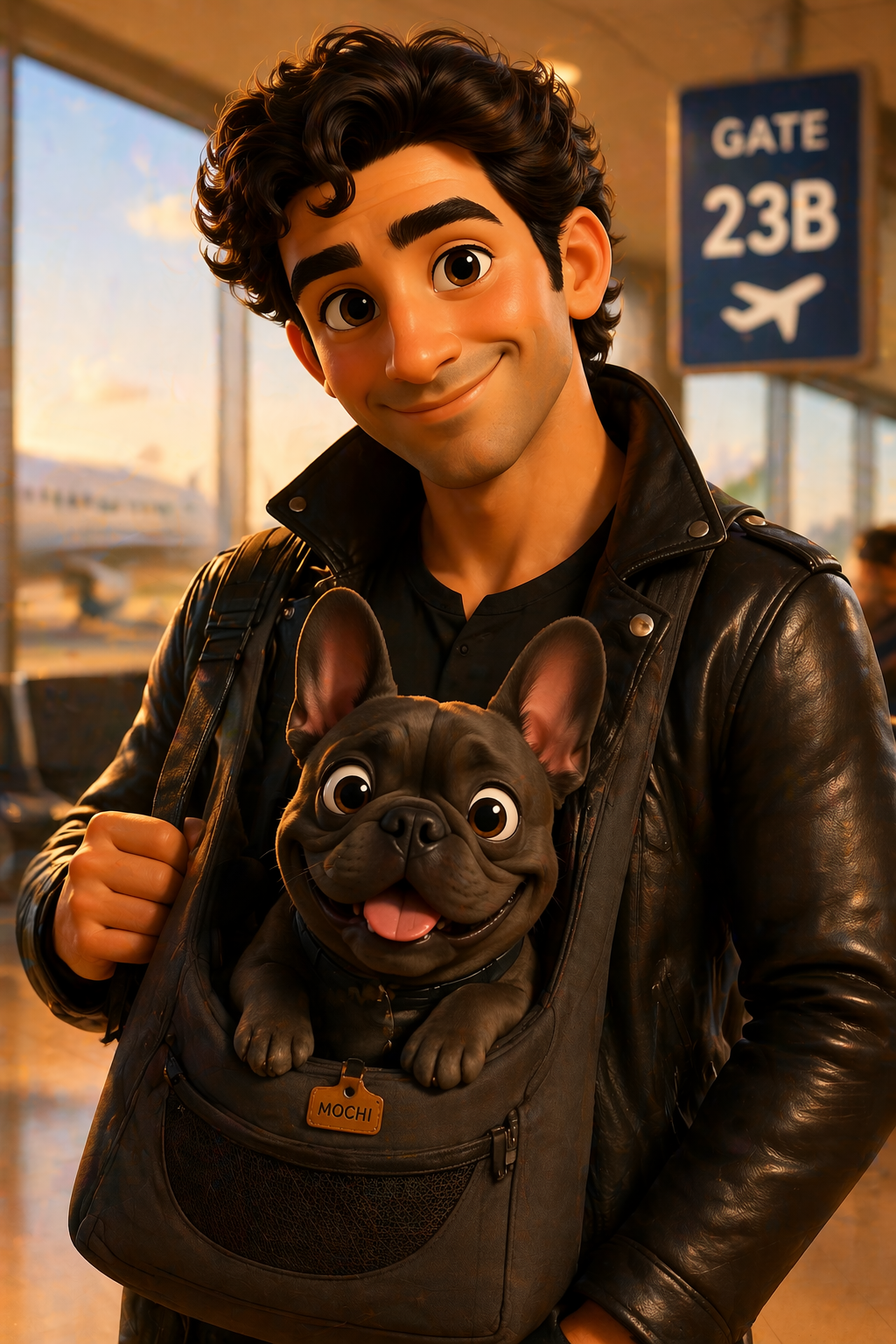
“I rescued Tafoukt from a shelter in Morocco and brought her home to Paris.”
Meet all guides →
Flying with Pets on Cathay Pacific: What You Need to Know
I remember the first time I flew a rescue dog from Morocco to Paris on a commercial airline. It wasn't Cathay Pacific, but the anxiety was real—not just mine, but the dog's too. That experience taught me that pet air travel isn't complicated, but it is precise. Cathay Pacific has clear rules, and understanding them before you book makes all the difference between a smooth journey and a cancelled flight.
Whether you're relocating a rescue from a shelter abroad, moving your family cat across continents, or reuniting with a beloved companion, this guide covers everything Cathay Pacific requires. I'll walk you through the options, the restrictions, and the practical steps that matter.
Can Your Pet Fly in the Cabin?
Here's the straightforward answer: no regular pets are allowed in Cathay Pacific's cabin. Only trained service dogs—those performing specific disability tasks—can travel with you in the cabin, and they must be harnessed or leashed at all times. No fee applies for service dogs on most routes, but US routes require DOT documentation.
This is actually an industry norm. Most long-haul carriers, including British Airways and Lufthansa, follow the same policy. The cabin environment—pressurization, noise, confined space—is genuinely stressful for most animals, which is why airlines route them through safer alternatives.
Your Pet Travel Options: Checked Baggage vs. Cargo
Cathay Pacific offers two ways to transport your pet: checked baggage or cargo. The choice depends on your route, your pet's size, and your timeline.
Checked Baggage Service (Limited Routes)
This is the more accessible option for most travelers. Your pet travels in the hold with climate control, alongside your luggage. Important limitation: checked baggage pet service is only available departing from Hong Kong (HKG).
If you're flying from elsewhere to Hong Kong and then onward, you'd need to arrange cargo for the first leg. This matters if you're, say, flying a rescue dog from Morocco to France via Hong Kong—you'd need to coordinate with a freight forwarder or partner airline for the initial journey.
Cargo Service (All Routes)
Cargo is mandatory for certain routes, including those to the United Kingdom, United Arab Emirates, and Hong Kong itself. Cargo also applies if your pet exceeds checked baggage weight limits or if you need more flexibility with timing.
Booking cargo is different: as of September 2025, you must book through an IPATA/ATA-certified freight forwarder or hold IPATA/ATA membership yourself. You cannot call the airline directly. This adds a layer of coordination, but freight forwarders handle the complexity—they know the regulations, the paperwork, and the timing.
Carrier Requirements: What Your Pet Travels In
The carrier is non-negotiable, and the rules differ by travel mode.
For Cabin Travel (Service Dogs Only)
Service dogs travel at their handler's feet, harnessed or leashed. No carrier required.
For Checked Baggage
Your pet needs a soft-sided carrier with specific dimensions:
- Maximum length: 45 cm
- Maximum width: 23 cm
- Maximum height: 23 cm
- Combined weight (pet + carrier): 7 kg maximum
The carrier must have:
- Mesh ventilation on all sides (IATA standard)
- An absorbent liner inside to manage accidents
- "Live Animals" labels with orientation arrows on the exterior
Soft-sided carriers fit under airplane seats and are designed for the hold environment. They're easier to transport through airports too.
For Cargo
Cargo requires a hard-sided, IATA-compliant crate—much sturdier than checked baggage carriers. Your freight forwarder will advise on exact dimensions based on your pet's size, but the crate must include:
- Hard-sided construction (plastic or wood, not soft-sided)
- Ventilation openings on at least three sides
- An attached water bowl or trough that can be filled from outside
- An absorbent mat or liner inside
- "Live Animals" labels with directional arrows
- IATA Live Animals Regulations (LAR) compliance
The water bowl is critical—handlers can refill it during layovers without opening the crate, keeping your pet hydrated and secure.
Health Certificates & Documentation
A veterinary health certificate is mandatory for all pet travel on Cathay Pacific, regardless of route or travel mode. This isn't optional—it will be checked at the airport, and without it, your pet won't board.
Timing matters: the certificate must be issued within 10 days of your departure date. Some destinations require 7 days, so aim for as close to departure as possible. Your vet should be familiar with international travel certificates; if not, ask them to reference IATA standards.
For US routes with service dogs, you'll also need DOT documentation. For any international move, check destination import requirements—many countries require rabies vaccination records, microchip registration, or import permits. A pet travel documents checklist can help you stay organized.
Breed Restrictions: Who Cannot Fly
Cathay Pacific bans certain breeds entirely across all routes and travel modes:
- American Pit Bull Terrier
- American Staffordshire Terrier
- Dogo Argentino
- Fila Brasileiro
- Japanese Tosa
- Sphynx cats (all routes)
Additionally, brachycephalic (snub-nosed) breeds face restrictions due to respiratory risks during flight. These include:
- Dogs: Bulldog (all types), Pug, Boston Terrier, Boxer, Chow Chow, Dogue de Bordeaux, English Toy Spaniel, Japanese Chin, Lhasa Apso, Mastiff (all types), Pekingese, Shar Pei, Shih Tzu, Staffordshire Bull Terrier, Affenpinscher
- Cats: Persian, Himalayan, Scottish Fold, Chinchilla
Some brachycephalic breeds are accepted on specific routes during cooler months: HKG-MEL and HKG-SIN routes allow certain brachycephalic dogs in January–May and October–December only. This reflects the heat embargo rules (see below).
If your rescue dog is a mixed breed with brachycephalic features, contact Cathay Pacific directly with photos and breed history. Many shelter dogs are mixed breeds, and airlines sometimes make exceptions with proper documentation.
Temperature Embargoes: When Your Pet Cannot Fly
Cathay Pacific will not transport pets if tarmac temperatures at origin or destination exceed certain thresholds:
- Heat embargo: 29.4°C (85°F)
- Cold embargo: 7.2°C (45°F)
This is a safety measure. Extreme temperatures in the hold can be dangerous, even with climate control. If you're flying during summer or winter, check the forecast for your departure and arrival cities. If temperatures exceed these limits, your pet's flight will be cancelled or rescheduled.
For cargo travel in cold conditions, a vet can issue an acclimation certificate confirming your pet is accustomed to cold weather, which may allow travel below the threshold. Ask your vet about this if you're traveling in winter.
Age Requirements
Your pet must be at least 16 weeks old for cabin travel (service dogs only) and 8 weeks old for checked baggage or cargo. Puppies and kittens must be fully weaned. Very young animals are physiologically vulnerable to flight stress, which is why airlines enforce these minimums.
Special Circumstances: Pregnant & In-Heat Animals
Cathay Pacific does not accept visibly pregnant animals for air travel due to health risks during flight. If your pet is pregnant, confirm directly with the airline before booking—some may make exceptions for early pregnancy.
Animals in heat: we're still verifying this—contact Cathay Pacific directly to confirm their policy.
Sedation: What You Must Know
Do not sedate your pet for air travel. IATA regulations prohibit sedation because a sedated animal cannot maintain equilibrium or respond to emergencies. This applies to virtually all commercial airlines worldwide. Unless your vet and the airline explicitly instruct otherwise (which is rare), leave the sedatives at home.
If your pet is anxious, work with your vet on calming techniques—exercise before travel, familiar bedding in the carrier, or natural calming supplements. But sedation itself is a greater risk than the flight.
Advance Booking: Plan Ahead
You must book your pet at least 48 hours in advance for checked baggage travel. For cargo, booking timelines vary by freight forwarder, but plan for at least 5–7 days ahead to arrange the crate, paperwork, and logistics.
Do not show up at the airport with a pet without prior arrangement. Airlines limit the number of pets per flight, and slots fill quickly, especially on popular routes.
Fees
For checked baggage, cabin pet fees are route-dependent, typically HKD 600–800 equivalent (roughly USD 75–100 or EUR 70–95). Exact pricing depends on your specific route.
For cargo, fees are determined by the cargo agent and not published in advance. Costs vary by pet weight, crate size, route, and fuel surcharges. A freight forwarder will provide a quote once you've booked.
See our pet travel costs guide for a broader breakdown of international pet transport expenses.
Key Numbers at a Glance
- Minimum age (cabin): 16 weeks
- Minimum age (cargo/checked baggage): 8 weeks
- Max pets per passenger (cabin): 1 service dog only
- Checked baggage carrier max dimensions: 45 cm L × 23 cm W × 23 cm H
- Checked baggage max weight (pet + carrier): 7 kg
- Health certificate validity: 10 days from issue
- Advance booking required: 48 hours (checked baggage); 5–7 days (cargo)
- Heat embargo: 29.4°C (85°F)
- Cold embargo: 7.2°C (45°F)
- Checked baggage fee: HKD 600–800 equivalent (route-dependent)
- Cargo fee: Quote-based (contact freight forwarder)
What You Need to Do: Actionable Checklist
- Confirm your route: Is it HKG-based (checked baggage available) or elsewhere (cargo required)?
- Check breed restrictions: Is your pet on the banned or brachycephalic list? If brachycephalic, confirm seasonal availability for your route.
- Schedule a vet visit: Get a health certificate issued within 10 days of departure. Confirm it meets international standards.
- Check temperature forecasts: Ensure tarmac temps at origin and destination stay within 7.2–29.4°C on your travel date.
- Book early: Contact Cathay Pacific (checked baggage) or a freight forwarder (cargo) at least 48 hours to 7 days ahead.
- Prepare the carrier: Soft-sided for checked baggage, hard-sided IATA-compliant for cargo. Include absorbent liner, ventilation, and labels.
- Arrange transport to/from airport: Plan how you'll get your pet to the airport safely and on time.
- Confirm destination requirements: Check import permits, quarantine rules, and microchip/vaccination requirements for your destination country.
- Keep copies: Bring extra copies of health certificates, booking confirmations, and carrier documentation.
A Personal Perspective on Pet Rescue & Air Travel
When I rescued Tafoukt from a shelter in Morocco, I knew I wanted to bring her home to Paris. She was 14 kg of nervous energy, a Border Collie mix with a rough start. Flying her wasn't just logistics—it was a second chance. That's what international pet travel means to me: it's not just for purebred show dogs or wealthy expats. It's for shelter animals finding families, for rescues getting medical care, for animals escaping difficult situations.
The regulations—the carriers, the certificates, the temperature checks—exist because airlines have learned, sometimes tragically, what happens when corners are cut. Every rule in Cathay Pacific's policy is there to keep your pet safe. Respect them, and your journey will be smooth.
Get your free personalized travel plan from Pawgo to coordinate all the details for your specific route and pet.
Final Reminders
- Service dogs only in cabin; all other pets travel in hold via checked baggage or cargo.
- Health certificate required; must be issued within 10 days of departure.
- Checked baggage available ex-HKG only; cargo available all routes.
- Brachycephalic breeds restricted; some banned entirely.
- No sedation. Ever.
- Book at least 48 hours ahead (
Auto-generated from verified data · Last updated: April 23, 2026