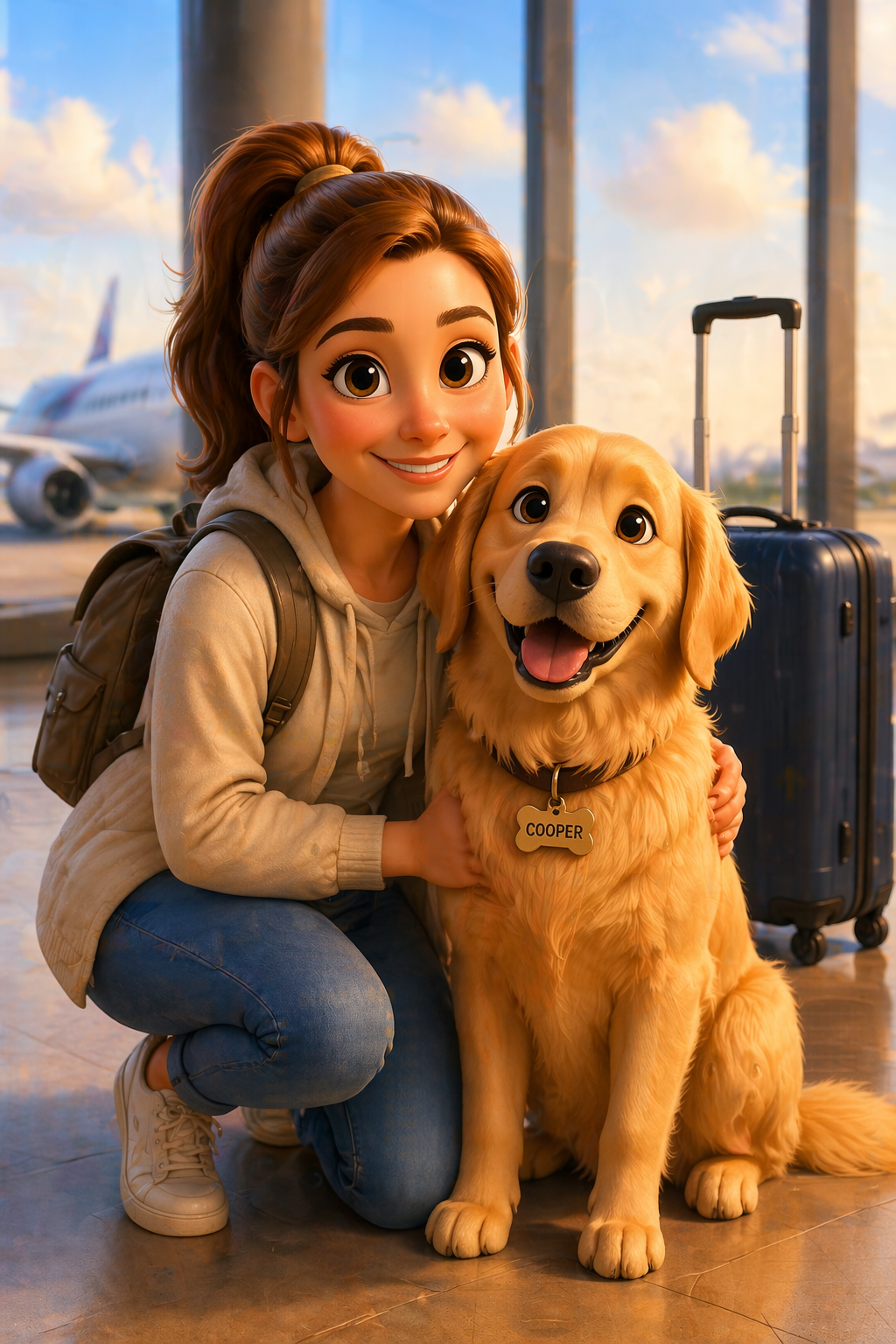
Booking a dog flight in 2026? Whether it's a cross-country move, an international relocation, or a vacation, this is the only guide you need. We walk through every step — from confirming your dog can fly at all, to choosing the right airline and crate, navigating paperwork, managing flight-day logistics, and clearing customs at your destination. The data behind this guide comes from the policies of 270+ airlines and 230+ countries we track continuously at Pawgo.
In this guide
- Check If Your Dog Can Fly
- Cabin vs. Cargo: Which Is Right?
- Required Documents: The Master Checklist
- Choosing the Right Airline
- Booking Your Dog's Spot
- Choosing and Preparing the Carrier
- The Week Before: Final Prep
- At the Airport: Step-by-Step
- Arriving at Your Destination
- Frequently Asked Questions
- Get Your Personalized Plan
Check If Your Dog Can Fly
Not every dog is cleared to fly. Before you book anything, verify these four things — any one of them can derail the entire trip:
- Breed restrictions: Brachycephalic (snub-nosed) breeds like French Bulldogs, Pugs, and Boston Terriers are banned from cargo on most airlines and restricted in cabin on some. See our full guide for snub-nosed breeds.
- Age minimum: Most airlines require dogs to be at least 8–12 weeks old and fully weaned. Puppies under 15 weeks cannot enter the EU at all because they can't be vaccinated for rabies early enough. For travel to the US from high-risk rabies countries, the CDC now requires dogs to be at least 6 months old.
- Health: Your dog must be healthy enough to fly. Dogs with recent surgery (less than 2 weeks), respiratory issues, uncontrolled heart disease, or late-stage pregnancy may be denied boarding by airline vets at check-in.
- Size & weight: Combined with its carrier, your dog must fit within airline-specific limits. Under ~10 kg total is usually cabin-eligible; anything heavier goes to cargo, if the airline offers it.
Pro tip: a 30-second check on Pawgo tells you instantly whether your specific dog, on your specific airline, for your specific route, is eligible.
Cabin vs. Cargo: Which Is Right?
This is the single biggest decision you'll make. It's driven almost entirely by your dog's weight:
Cabin (small dogs, under ~8–10 kg with carrier): Your dog travels in a carrier under the seat in front of you. This is safest and least stressful — you can talk to them, monitor them, and the cabin is fully climate-controlled. Typical max carrier dimensions are 45×35×20 cm, but exact figures vary per airline. Most carriers also limit the number of pets in cabin per flight (usually 1–2 dogs), so book early.
Cargo (medium and large dogs): Your dog travels in a pressurized, climate-controlled hold, inside an IATA-compliant crate. The cargo hold is safe when used properly, but: (1) you can't monitor them, (2) temperature embargoes can delay your flight, and (3) the preparation is much more involved (bigger crate, boulted corners, water bowl, absorbent bedding).
Checked baggage (an older option, becoming rare): Some airlines let small dogs travel as checked baggage, which is basically cargo but cheaper and tied to your ticket. This is being phased out by most carriers in favor of dedicated pet cargo programs.
Pro tip: Pawgo checks your exact dog's dimensions against every airline's carrier limits automatically — including the often-forgotten height limit, which is where most people get denied at the gate.
Required Documents: The Master Checklist
Documents are where most pet travel plans unravel. Requirements vary wildly by destination, but here are the documents you will very likely need for any international flight:
- Microchip: An ISO 11784/11785-compliant 15-digit microchip, implanted before the rabies vaccination. If your pet was vaccinated before being microchipped, many countries will consider the vaccination invalid and require re-vaccination.
- Rabies vaccination: Must be current. The EU requires at least 21 days between primary vaccination and travel. The US requires dogs from high-risk rabies countries to have rabies vaccination + a serology titer test + a CDC Dog Import Form.
- Health certificate (APHIS 7001 or equivalent): Issued by a licensed vet within 10 days of travel. For international flights, it usually needs endorsement by your country's government veterinary authority — USDA APHIS in the US, APHA in the UK, DDPP in France, CFIA in Canada.
- Rabies titer test (FAVN): Required for Japan, Australia, Singapore, Malaysia, UAE, and others. Involves a 180-day waiting period from blood draw to arrival.
- Import permit: Required for Australia, New Zealand, Singapore, Japan, and others. Can take 2–8 weeks to process, so apply early.
- Parasite treatment: Ireland, Finland, Norway, and Malta require tapeworm (Echinococcus) treatment 1–5 days before arrival. The UK used to, still check current policy at time of booking.
For the full breakdown, see our Pet Travel Documents Checklist. For country-specific rules, check your destination.
Choosing the Right Airline
Not all airlines are created equal when it comes to pets. Some treat them as VIPs; others refuse them entirely. Here's what to compare:
- Cabin vs. cargo availability: Some airlines only allow small dogs in cabin (e.g., Delta discontinued pet cargo). Others only offer cargo (British Airways). A handful offer both with equal attention.
- Carrier size limits: Ranges from restrictive (Lufthansa 55×40×23 cm) to very restrictive (some US regional carriers under-seat). Measure your carrier, don't guess.
- Fees: Cabin fees range $50–$200 one-way. Cargo fees range $200–$500+ depending on crate size and distance. See our cost breakdown guide.
- Breed bans: Some airlines ban all brachycephalic breeds; others only restrict them from cargo. A few still ban certain "aggressive" breeds entirely.
- Temperature embargoes: Most airlines won't transport pets in cargo when ground temps exceed 29°C (84°F) or drop below 7°C (45°F). This can strand you at the airport if your flight gets re-routed.
- Cabin pet count per flight: Most airlines cap cabin pets at 2–6 total per flight, sometimes 1 per cabin class. Booking weeks in advance matters.
- Booking method: Many airlines still require phone bookings for pets — you cannot add a pet online. This is where people lose time.
See our Best Pet-Friendly Airlines 2026 ranking, or go straight to our full airline policy database.
Booking Your Dog's Spot
Most airlines require you to call to reserve your pet's spot — you can't book pets online on most carriers. Do this as early as possible, because cabin spots are limited (often 1–2 per flight) and fill up weeks in advance on popular routes.
What you'll need when calling:
- Your booking reference (book your own seat first)
- Your dog's breed, weight, and exact carrier dimensions (length × width × height)
- Whether the trip is one-way or return (affects cargo preparation)
- Your dog's health certificate status (they may not need it at booking, but they'll check before check-in)
- For cargo: crate make/model, ventilation side count, water bowl confirmation
Pricing confirmation: Ask for a written confirmation of the fee. It's not unusual for airline agents to quote different prices on different calls — get it in writing before paying.
Travel within 24 hours of ticketing: Some airlines won't accept last-minute pet bookings. Give yourself at least 48 hours lead time for cabin, and 7–14 days for cargo.
Choosing and Preparing the Carrier
Your carrier is the one thing you have complete control over — and a bad carrier is the #1 reason pets get denied at check-in. Three types, different rules:
Soft-sided carrier (cabin only): Flexible, lightweight, fits under seats. Most comfortable for small dogs. Look for reinforced structure (not just soft mesh), padded floor, and a top zipper you can unzip at cruising altitude for airflow. Trusted brands: Sherpa, Sleepypod Air.
Hard-sided plastic carrier (cabin or cargo): More protective, easier to clean. Required by a few strict airlines even in cabin. For cargo, must be IATA-compliant.
IATA-compliant cargo crate: Rigid plastic or fiberglass, with bolted corners (not just clipped), ventilation on at least 3 sides, metal door with double-lock, and an attached water bowl. Dimensions must allow the dog to stand without ears touching the top, turn around comfortably, and lie down.
Measuring your dog: Length = nose to tail base (not tail end). Height = floor to top of head, ears up. Width = shoulder to shoulder. Add 5 cm to each dimension when sizing the carrier. When in doubt, size up.
Carrier conditioning: Start at least 3–4 weeks before the flight. Leave the carrier open at home with treats and a familiar blanket inside. Feed the dog inside. Take short car rides in it. A dog who thinks of the carrier as a comfortable den will travel far better than one who's only ever been zipped into it at the airport.
The Week Before: Final Prep
Seven days out, the clock starts ticking on the health certificate. Here's the last-week checklist:
- 7 days out: Book the vet appointment for 5–7 days before departure. Confirm the vet is USDA-accredited (or equivalent in your country).
- 5–7 days out: Vet appointment — health exam, microchip scan, vaccination record verification, health certificate completion.
- 3–5 days out: Health certificate endorsement by government authority (USDA APHIS, APHA, DDPP). Allow 2–3 business days; some regions offer same-day VEHCS electronic endorsement.
- 2 days out: Print all documents (at least 3 copies). Confirm your carrier fits in the sizer at a trial run at your local airport if possible.
- 24 hours out: Freeze a small water bowl for cargo (prevents spills while still allowing water to melt during the flight). Charge your phone.
- Day of: Light meal 4–6 hours before flight. Long walk or play session right before leaving for the airport. No sedation.
Why no sedation? Sedatives relax airway muscles and alter body temperature regulation. At cruising altitude, both can become dangerous. The AVMA, IATA, and virtually all airline vets advise against sedation. Natural calming aids (Adaptil collars, calming treats, familiar blankets) are fine.
At the Airport: Step-by-Step
Airport logistics are where stress peaks. Arrive with time to spare.
- Arrive 3 hours early for international flights with a pet. For domestic, 2 hours is usually enough.
- Check in at the counter, not the kiosk. The agent will verify documents, weigh the carrier, and issue pet tags.
- For cargo: You'll go to a separate cargo terminal, usually a 10-minute drive from the passenger terminal. Drop-off typically happens 3–4 hours before departure.
- Security (cabin pets only): You'll take your dog OUT of the carrier and carry them through the metal detector while the carrier goes through the X-ray. Bring a slip lead — a loose dog in TSA is a nightmare.
- Pet relief areas: Most major airports have them, but they're often in odd locations. Search "pet relief area [airport code]" before you arrive.
- At the gate: Keep the dog in the carrier. Stay calm — dogs mirror human anxiety.
- On board: Put the carrier under the seat (not your lap, not an empty seat). Do not open it during the flight. Verbal reassurance is fine.
Arriving at Your Destination
At the destination airport, expect one more layer of process:
- Customs and animal inspection: Present all documents. In the EU, this is usually quick. In Australia, Japan, and the UK, it can involve 12–24 hours of on-site quarantine inspection, even with perfect paperwork.
- Retrieving cargo pets: You'll go to the cargo terminal, not baggage claim. Allow 1–2 hours after landing.
- First 24 hours: Offer water immediately. Light meal only after 2–3 hours. Expect some disorientation — treat your dog gently, and don't be surprised if they sleep 14+ hours the first day.
Frequently Asked Questions
Can I buy a separate seat for my dog?
No. Dogs must travel under the seat in front of you (cabin) or in cargo. Buying an extra seat for more room doesn't help — the carrier still has to fit under the seat.
Can my dog sit on my lap during the flight?
No. Airlines require pets to remain inside their carrier for the duration of the flight, including taxi, takeoff, cruise, and landing.
What happens if there's turbulence or an emergency?
The carrier stays closed. In an emergency evacuation, airline staff instruct you to leave the carrier behind — your dog's safety is tied to staying out from underfoot during evacuation.
Can my dog hear the engines?
Cabin noise is roughly 75–85 dB, similar to a busy restaurant. A calming blanket over the carrier muffles it further.
What if my dog pees in the carrier?
Use an absorbent pee pad inside the carrier. Bring 2–3 spares. Accidents happen, and airlines don't penalize you for this.
Should I book a direct flight?
Always, if possible. Every layover multiplies risk: more handling for cargo, more security screenings for cabin, more chances of cargo hold temperature embargoes.
Can I switch my dog from cargo to cabin last-minute?
No. These are booked under entirely different categories. Change means cancellation + rebooking, often with fees.
Get Your Personalized Plan
Every trip is different. Your dog's breed, size, airline, and destination country all change what's required — and a single missed document can mean your dog is refused at the gate.
Instead of piecing together information from dozens of sources, get a free personalized travel plan from Pawgo. It takes 30 seconds and covers everything: documents, deadlines, vet appointments, airline-specific carrier dimensions, and country-specific rules for your exact route.
Related reading: Documents checklist · Snub-nosed breed guide · Best airlines for pets · Cost breakdown.