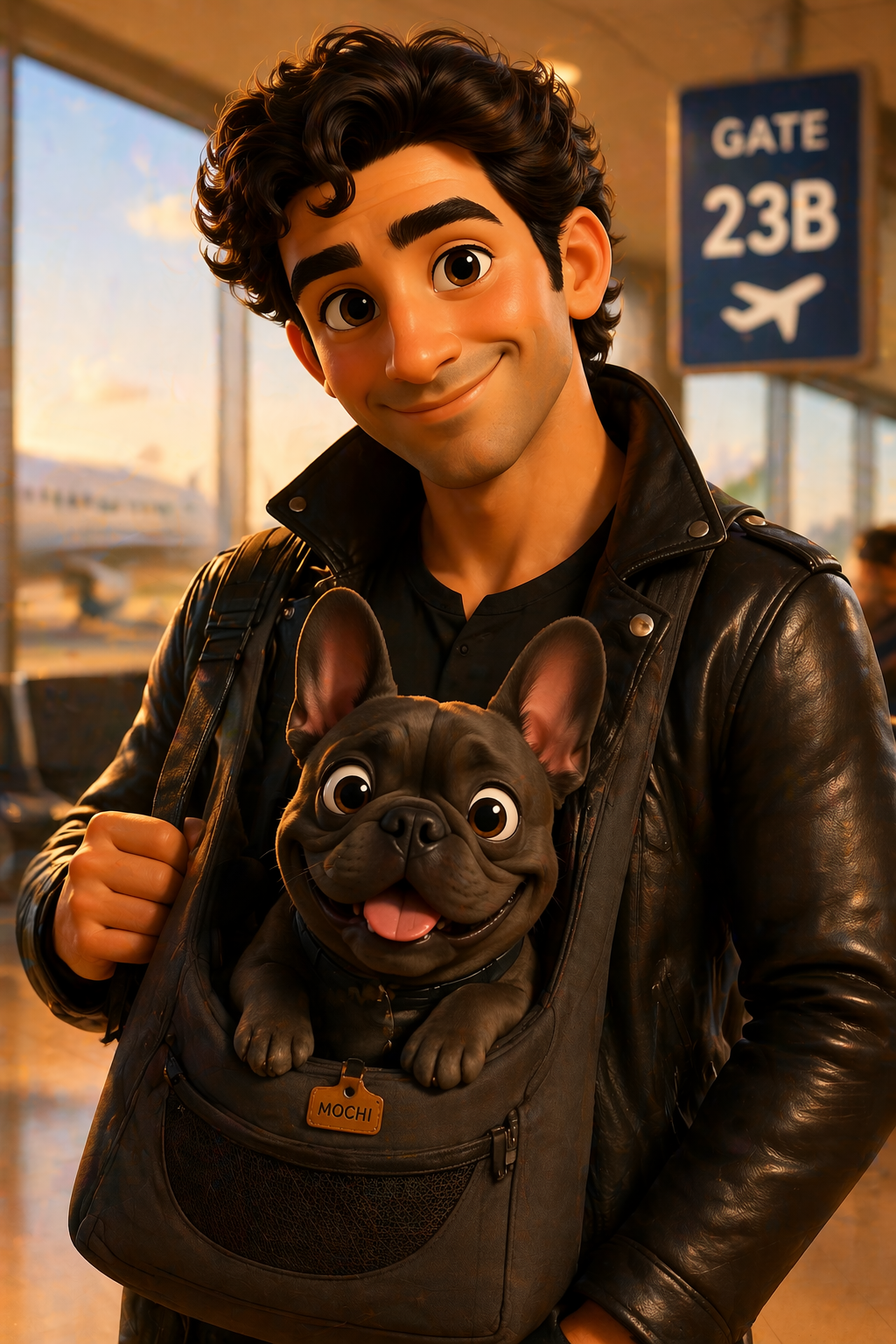
If you own a French Bulldog, Pug, Boston Terrier, or Persian cat, the internet is full of fear about flying. Here's the reality based on a 2026-05-02 audit of 270+ airline pet policies: most major airlines DO accept snub-nosed breeds in the cabin — the bans almost always apply to the cargo hold only. The trick is knowing which airlines, which modes, and which conditions.
In this guide
- The Cabin vs. Cargo Distinction (this is the whole story)
- Airlines That Welcome Snub-Nosed in the Cabin
- Airlines That Ban Brachycephalic Breeds Entirely
- Airlines That Ban Brachycephalic Only in the Hold
- The Breeds That Count as Brachycephalic
- Temperature Embargoes — The Other Killer
- Tips for Flying With a Brachycephalic Pet
- What Pawgo Does Automatically
The Cabin vs. Cargo Distinction (this is the whole story)
Snub-nosed (brachycephalic) breeds have anatomically compressed airways that make breathing harder under stress. The risk during air travel is real — but it's not equal across travel modes. The danger lives in the cargo hold, where temperature swings, vibration, and limited monitoring multiply respiratory stress. The cabin is a different environment: pressurised, climate-controlled, and right under your seat where you can see your pet.
That distinction is reflected in airline policies once you read them carefully. Lufthansa, Air France, KLM, Iberia, Hawaiian Airlines, Belavia and many others explicitly accept brachycephalic breeds in the cabin while banning them in the hold. The "no flat-faced dogs" headlines you've read mostly refer to cargo policy.
Airlines That Welcome Snub-Nosed in the Cabin
The following carriers allow brachycephalic breeds in the cabin (subject to weight/size limits, typically ≤8 kg combined with carrier):
- Lufthansa (LH) — cabin ≤8 kg, small snub-nosed pets routinely accepted; banned from cargo hold.
- Air France (AF), KLM (KL/WA) — same pattern: cabin yes, hold no for brachy.
- Iberia (IB) — explicitly accepts brachycephalic breeds in cabin; refers cargo to Woof Airlines partner.
- Hawaiian Airlines (HA) — brachycephalic OK in cabin if carrier fits under seat; not accepted in cargo.
- British Airways (BA) — small brachy accepted via IAG Cargo with conditions.
- Belavia (B2) — explicitly: brachy banned in baggage / cargo, allowed in cabin.
- United (UA), JetBlue (B6), Delta (DL), American — cabin only, no breed restrictions on small dogs/cats.
See every airline's cabin/cargo brachy policy in our comparison index — the bulldog-face icon next to each card tells you at a glance.
Airlines That Ban Brachycephalic Breeds Entirely
A smaller group bans snub-nosed breeds from every mode (cabin AND cargo):
- Spirit Airlines (NK) — aggressive and snub-nosed dog/cat breeds not accepted at all.
- Vueling (VY) — brachycephalic explicitly excluded from cabin (Bulldogs, Pugs, Boston Terriers, Boxers, etc).
- EgyptAir (MS) — not accepted as checked or unchecked baggage.
- VivaAerobus (VB) — passengers with brachy breeds must sign a release of liability; not standard service.
- Jetstar (JQ) — no general pet acceptance at all; brachy specifically excluded.
Plus airlines that don't carry pets at all (which trivially excludes brachy too): IndiGo, EasyFly, Spring Airlines, several Korean LCCs.
Airlines That Ban Brachycephalic Only in the Hold
This is the most common pattern — if your pet is small enough to fit cabin limits, you're usually fine. If it isn't, the hold is closed:
- Most Lufthansa Group (LH, LX/Swiss): cabin yes, hold explicitly banned for snub-nosed.
- Emirates SkyCargo (EK) — cabin not offered at all; cargo banned for brachy except limited Nov-Apr winter window.
- Singapore Airlines (SQ), Qatar Airways (QR) — cabin not offered for general pets; brachy explicitly banned as checked baggage / cargo.
- TUIfly (X3) — cabin yes ≤8 kg; brachy banned in hold.
- Korean Air — cabin yes (size-permitting); explicit brachy ban in hold with full breed list.
The Breeds That Count as Brachycephalic
Dogs: Affenpinscher, Boston Terrier, Boxer, Brussels Griffon, Bulldog (English, French, all variants), Bullmastiff, Cane Corso, Cavalier King Charles Spaniel, Chow Chow, Dogo Argentino, Dogue de Bordeaux, Japanese Chin, King Charles Spaniel, Lhasa Apso, Neapolitan Mastiff, Pekingese, Pug, Shar-Pei, Shih Tzu, Tibetan Spaniel.
Cats: British Longhair, British Shorthair, Burmese, Exotic Shorthair, Foldex (Exotic Fold), Himalayan, Persian, Scottish Fold, Selkirk Rex.
Mixed-breed dogs that visibly inherit the flat face are usually treated the same way as purebreds at check-in. If you're unsure, ask the airline before booking, not at the gate.
Temperature Embargoes — The Other Killer
Even airlines that accept brachy in the cabin or hold often pull the plug when forecast temperatures cross seasonal thresholds. Common triggers:
- Above ~29°C / 85°F at any airport on the route — pets refused as checked baggage / cargo (Singapore, Pegasus, TUIfly, Hawaiian, others).
- Below ~7°C / 45°F — some airlines refuse without an acclimation certificate.
- Brachycephalic-specific lower thresholds — many carriers tighten by 5–10°C for snub-nosed pets specifically.
If you're flying a snub-nosed pet in summer, plan an early-morning or late-evening departure. Mid-day flights from hot-weather hubs are the highest-risk slots.
Tips for Flying With a Brachycephalic Pet
- Fly cabin if you possibly can. Cargo is where the real risk lives, and most major carriers will let cabin-eligible brachy fly.
- Pick a direct flight. Connections double the tarmac time, the temperature exposure, and the chance of weather embargoes triggering.
- Watch the weather. Avoid summer mid-day departures. Many incidents trace back to a heat-stressed dog already exhausted before the cabin door closes.
- Choose mesh ventilation, not hard plastic. Soft-sided cabin carriers with mesh on three sides give the best airflow under-seat.
- Don't sedate. Sedatives relax airway muscles, which is exactly what a snub-nosed breed cannot afford. Most carriers and airline vets actively refuse to fly sedated pets.
- Hydrate before and after. Stick a frozen water dish in the carrier at boarding so it's drinkable mid-flight.
- Carry a vet fitness-to-fly letter. Some airlines (Lufthansa cabin, Singapore checked baggage) ask for one specifically because of the breed.
What Pawgo Does Automatically
When you enter your pet's breed in Pawgo, we run a few checks for you:
- Cross-reference your airline's per-mode brachycephalic policy — cabin yes vs. cargo no is a different answer than "banned".
- Confirm your pet+carrier weight is under your airline's cabin cap (the limit that lets brachy avoid the hold).
- Flag temperature embargoes that apply to your travel date and route.
- Surface the airline-specific restricted breed list — Emirates and Korean Air both publish very specific lists you should match against.
Check your breed's eligibility now — it's free, it's specific to your itinerary, and it takes 30 seconds.