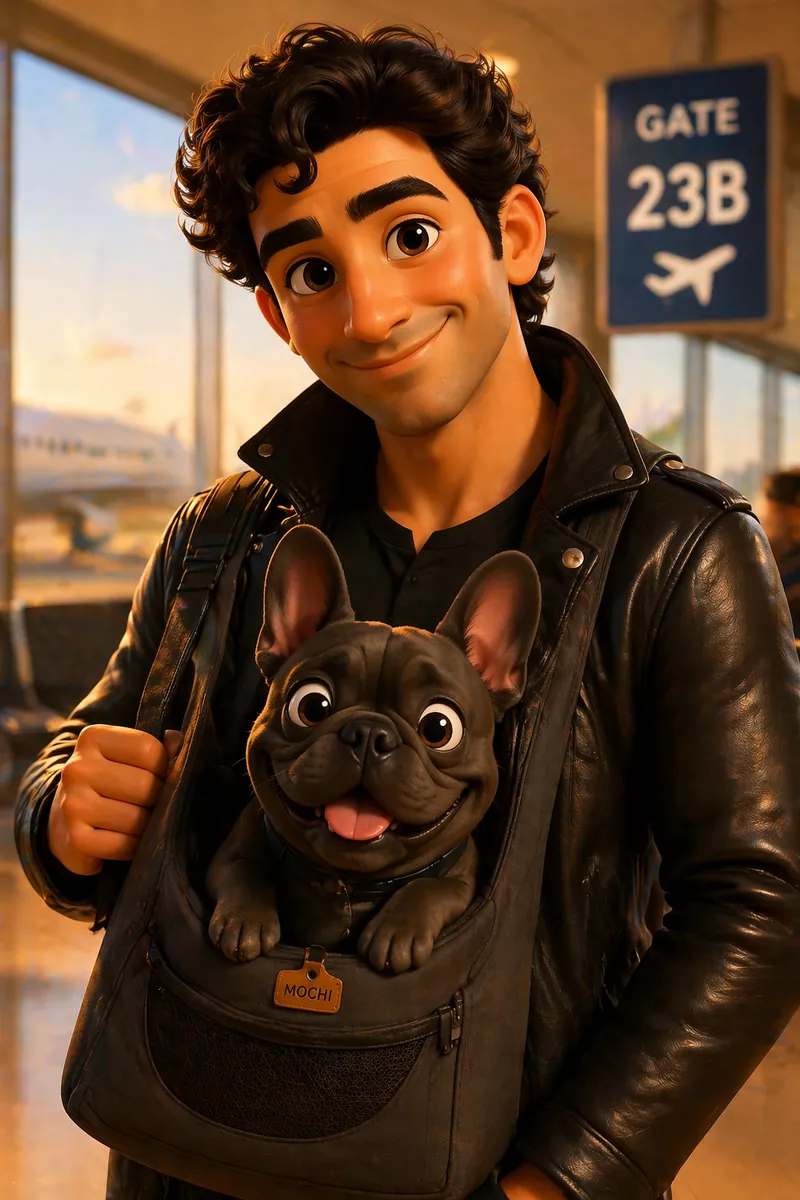
Marco · with Mochi (French Bulldog, 6kg) “Mochi judges the queue length, not me.” Meet all guides →
About this guide ↓
This guide was generated by Pawgo's AI using verified data from official sources. Marco is a fictional persona — the data is real.
Here's what nobody tells you about SWISS: the snub-nosed restriction closes both the cabin and the hold, and the list runs longer than the usual suspects. Mochi is a French Bulldog, so this is the kind of page I read twice before believing. If your dog is on that list there is no mode left to fall back on — which makes SWISS a decision rather than a booking.
Swiss's pet policy splits into cabin and cargo. This page summarizes the weight limits, fees, brachycephalic-breed restrictions, and carrier specifications for both modes — sourced from the airline's official pet pages.
How Swiss handles your pet
Each fact comes straight from the operator’s published policy. Tap the to read the exact wording; the opens the source page.
In the cabin✓ Accepted
In the hold / cargo✓ Accepted
Snub-nosed breedsAccepted
Cabin policy
Pets accepted✓ Acceptedverified 2026-10-16
Snub-nosed breeds banned✓ Noverified 2026-10-16
Minimum age12 weeksverified 2026-10-16
Advance booking notice72 hoursverified 2026-10-16
Advance booking required✓ Yesverified 2026-10-16
Max pets per passenger2verified 2026-10-16
Banned breeds list
American Bulldog
American Pit Bull Terrier
Staffordshire Bull Terrier
American Staffordshire Terrier
American Bully
Dogo Argentino
Rottweiler
Caucasian Ovcharka
verified 2026-10-16
Pregnant animals accepted✗ Noverified 2026-10-16
Carrier size55 × 40 × 23 cmverified 2026-10-16
Max weight (pet + crate)8 kgverified 2026-10-16
Crate must have/besoft-sided ok, a carrierverified 2026-10-16
Cargo: Crate must have/behard-sided ok, water bowl, ventilated, IATA-compliant, absorbent liner, live-animal label, a carrierverified 2026-10-16
SWISS checks availability and completes the booking no later than 72 hours before departure. The pet space is therefore arranged by the airline rather than added by you at checkout, and the 72 hours are the latest point at which that can happen. Call to request the space as soon as the ticket exists, not three days out.
The snub-nosed restriction names Lhasa Apso, Pekinese, Pit Bull, Shar Pei, Shih Tzu, Staffordshire Bull Terrier and Tibetan Spaniel among dogs, with British Shorthair, Exotic Shorthair, Himalayan, Persian and Scottish Fold among cats, and it applies to crossbreeds of those breeds too. A separate dangerous-dog classification covers the American Bulldog and Caucasian Ovcharka. Check both lists.
For tickets issued after 1 April 2021, animals transported in the hold attract a supplement of EUR 150 / CHF 170 / USD 170 / CAD 220 for transfers via Geneva, Frankfurt, Vienna and Zurich. The charge is tied to a transfer through those hubs rather than to every hold booking, so a direct routing may avoid it. Confirm the routing before pricing the trip.
So SWISS: a 72-hour booking handled by the airline, 8 kg in the cabin with the bag, and a snub-nosed ban that covers cabin and hold and crossbreeds alike. Here's what I wish someone had told me — check the breed list before the fare, because a ban on both modes is not something a different ticket solves. Build a personalized plan and we'll show which carriers leave a mode open.
ISO 11784/11785 — the universal microchip standard.
FAVN
Fluorescent Antibody Virus Neutralization — a rabies serology test required by rabies-free destinations.
Brachycephalic
Snub-nosed breeds (French Bulldogs, Pugs, Persians, Himalayans) with restricted airline acceptance due to heat-stress risk.
AVIH
Animal Vehicle In Hold — IATA's term for cargo pet shipment, with fees that vary by carrier and route.
Auto-generated from verified data · Last updated: August 30, 2026
Frequently Asked Questions
Can I bring my dog in the cabin on Swiss?
Yes, Swiss allows dogs in the cabin. Your pet and carrier combined must weigh under 8 kg. For your specific pet's eligibility, check Pawgo at www.pawgo.fr.Build my pet's travel plan →
Does Swiss allow brachycephalic (snub-nosed) breeds?
Swiss bans brachycephalic breeds from cargo. Breeds like French Bulldogs, Pugs, and Persian cats are affected. Verify your breed at www.pawgo.fr.Build my pet's travel plan →
What are the pet carrier size limits for Swiss?
The cabin carrier limit on Swiss is 55 x 40 x 23 cm (L x W x H). Exact limits vary by aircraft. Compute your carrier fit at www.pawgo.fr.Build my pet's travel plan →
Yes, Swiss offers cargo pet transport. Confirm the carrier's specific crate and documentation requirements with the airline directly before booking. Get the full details at www.pawgo.fr.Build my pet's travel plan →
Snub-nosed breeds such as bulldogs, pugs and Persian cats are not accepted in the cabin, not accepted in the hold.Build my pet's travel plan →
How far in advance must I book my pet on Swiss?
Add your pet to the booking at least 72 hours before departure — do it when you book the ticket, not at the airport.Build my pet's travel plan →
What if my flight is delayed past my health certificate validity?
If the certificate window expires before you board, you'll need a re-issue. Build a 1-2 day buffer between the cert date and departure to absorb minor delays.Build my pet's travel plan →
What happens if I forget a document?
At the destination airport: at best, an extended inspection while you produce backup; at worst, the pet is held in quarantine or returned to origin at your cost. Bring printed copies.Build my pet's travel plan →
Flying Swiss?
Get a personalized travel checklist for your pet on Swiss.